A LUCKY CURSE
[Lodown Magazine – Berlin, Germany]
by Renko Heuer
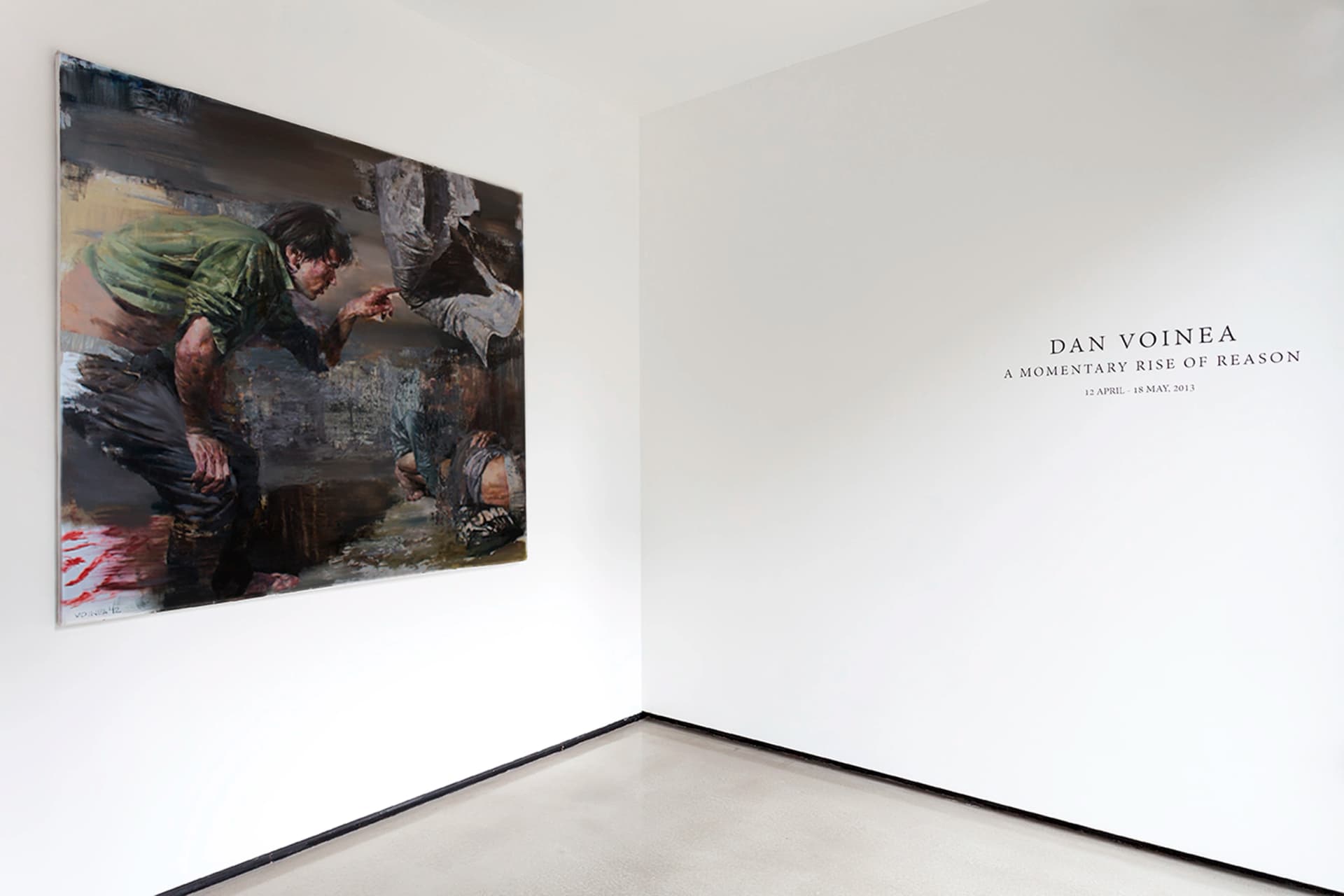
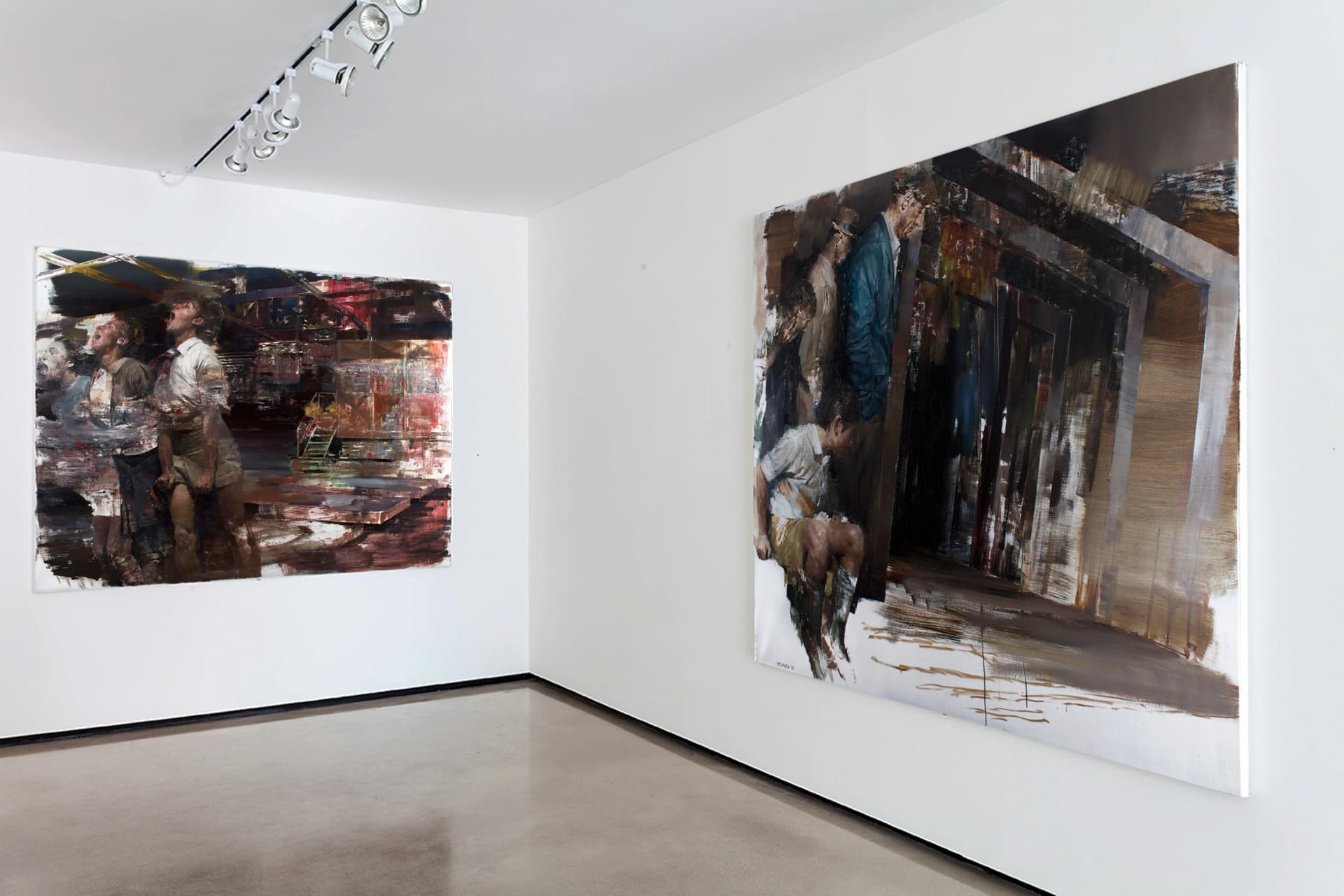
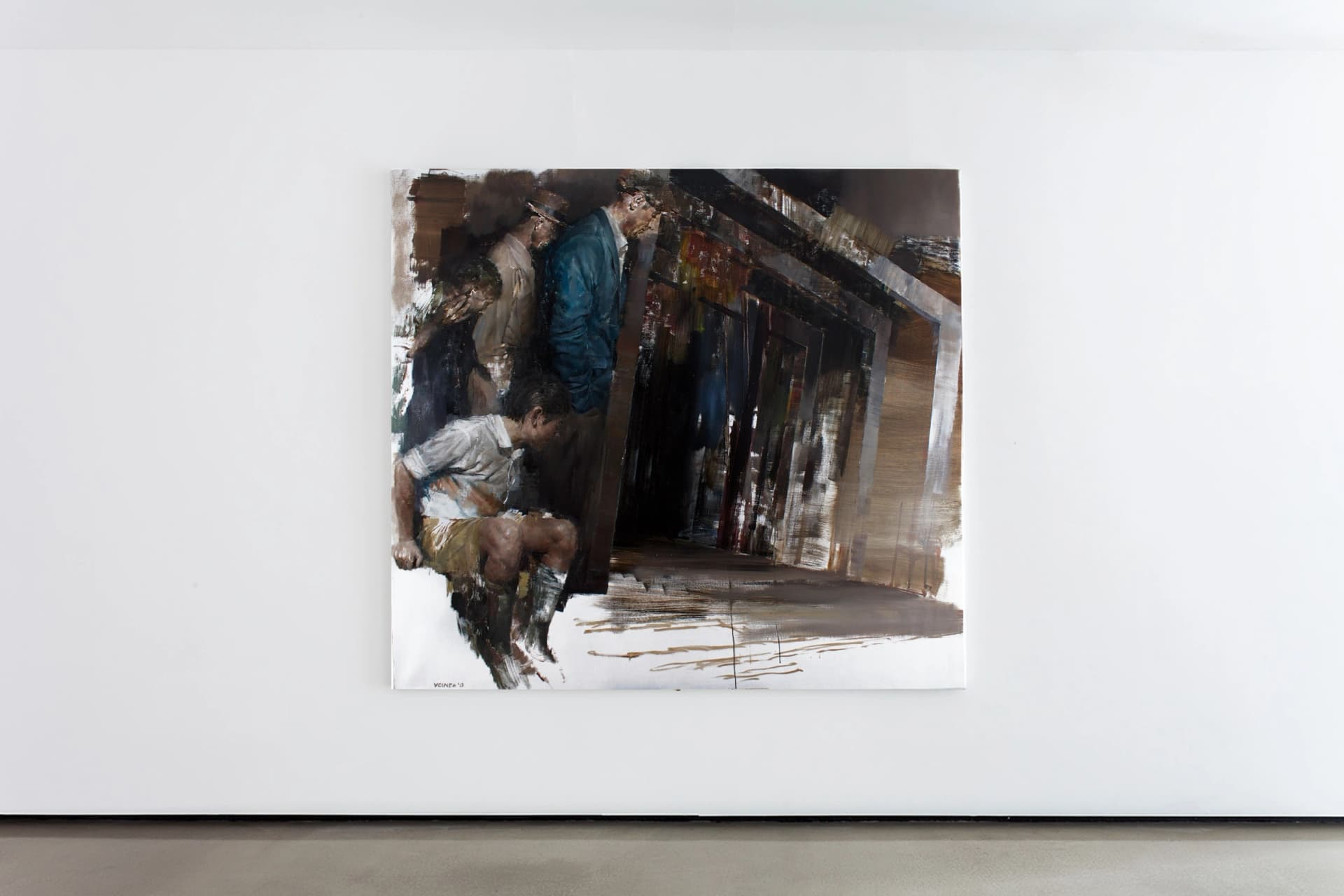
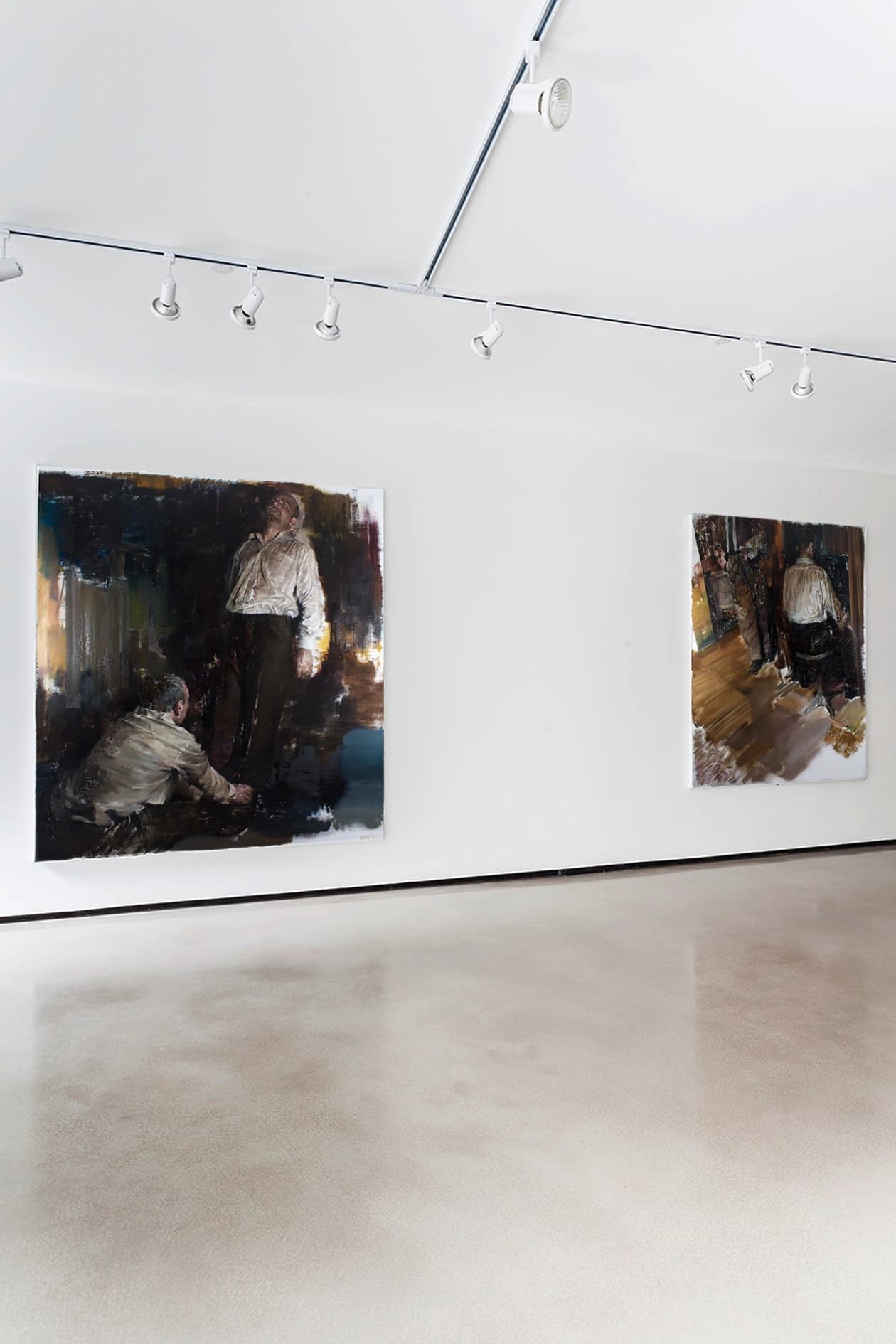
Hailing from Bucharest, Romania, Dan Voinea’s figurative paintings always veer towards the abstract and surreal, and there’s always something very, very unsettling about them, something like an existential threat, like a crack in what most people believe to be right and true. Having quit his former job in advertising to focus on his artistic output quite recently, he luckily found the time to chat with Lodown about professionalism, growing up in a totalitarian system, and his fear of growing a gut.
When did you first realize that you’re obsessed with professionalism?
It was when I completed a work and, instead of framing it, I felt like throwing it to a rubbish bin. It hurts a bit at first, yes, but you get used to it. But then, am I really obsessed with professionalism or is it only a fear of being conventional?
In your case, does that mean we’re only talking painting here – or are you steering towards professionalism in other areas as well?
I worked in advertising from 2000 to 2011, and it was a highly competitive environment. And, mind you, ex-communist Eastern European countries had no tradition in that respect. There is so much more to say about professionalism, but surely there are others who are much more entitled than me to speak about it.
So, painting: What did your works look like when you just started out, at age 5?
Nothing special, really. There were mere horse-looking drawings, at best. It was kind of a play I never had enough of.
As you get older – does it get easier to paint or just the other way around?
The older I get, the more exigent I become. Besides, that which comes easily, bores you even more easily. I instinctively head towards more difficult stuff, as I train for the inaccessible. I am obsessed with performance. When I get over it, I may well be ready to paint Byzantine, Orthodox icons.
How about life in general (as for easier vs. more difficult)?
Outside work, I am more balanced. I simply cannot be absorbed by painting as long as my inner life is troubled.
I guess it (life) must have felt somewhat difficult back in 1987 when the fuss about those anti-communist messages came up... right?
At the time I couldn’t tell the difference between a totalitarian regime and a democratic one. I did see the risks involved in an over-democratic society – after all, I was born in a strict and totalitarian country, I got used to obey the rules because I grew in such a system. When I was about to be expelled from school, I surmised that adults, too, feared something. Or somebody, I should say…
What is so scary about being conventional? And how can you ever be sure that in a world that’s so much about individuality and personality, that trying to avoid conventionality isn’t a convention in itself?
I’m not concerned with my attitude as a human being and as an artist. It’s not this kind of attitude that is judged upon. We could talk for hours on end about what being “conventional” means, if you want, but I only used it pejoratively. I can afford being conventional, yet, what matters most is that art shouldn’t be conventional, lifeless, and soulless. Still born art is nonsense.
11 years of advertising... that’s a long time. What are some of the main lessions that decade taught you? What was the worst part?
Team work in an advertising agency disciplines and makes you feel responsible. Those famous deadlines are so rigid that make you maximize your effort. Working in advertising has been teaching me the tough lesson of efficiency. What I must have found the hardest to bear in those 11 years was the lack of identity.
(Who’d be more entitled to speak about professionalism?)
I find it rather inappropriate to talk about professionalism since I’ve been a professional painter for only three years.
But you are a professional in the sense that you don’t do any other job apart from painting, am I right?
I do believe that such definition is the best way to describe my current state.
How come you feel you need to train for the inaccessible? What is so intriguing about the inaccessible? (And why share that kind of work with other human beings)?
I think each of us is fascinated by what he can’t seem to do. It’s unbearable to feel weak. When I paint, I try to push the limits and I guess any artist will do so, I’m not the only one. An artist wants by nature both to find new means of expression and to share his work. It’s a sort of feedback, it you like. There wouldn’t be any exhibitions otherwise, would there?
So painting isn’t a way to achieve order in life (as in catharsis, in a sense)? You need the state of order first… but don’t the images you paint (the scenes you create on canvas) almost threaten that order?
Even if the world of images I create may be the result of emotion, it has no power on me. My paintings have a single risk factor (which can damage the harmony we are talking about): their own failure. But then, it’s like in any other job, so you can get used to it. On the other hand, an image can shock its audiences alone; it never shocks the artist who created it. When my mother would finish making pan cakes in the kitchen, she hardly tasted one. She found no more joy in making them :-).
You once said that you tried to paint less and less “like yourself” – why? Isn’t it a greater achievement to find that “voice”, that “style” that is yours and work on it forever after?
Artistic identity is an ideal you keep working on until your last breath, but this is not what I meant. I was just referring to my little moments of dissatisfaction. It was a way of making myself more aware of my own imperfection.
You sound so very serious in what you’ve said so far, what made you become such a serious man?
I don’t know, maybe your (own) questions :) Painting is a subject I can’t afford to take lightly, even though I do believe that an artist mustn’t always take himself too seriously. However, I also think that if one leaves advertising and tries to make a living by painting, he must at least have a sense of humor.
And how exactly is painting an expression of your own desperation?
Now, see? If you’re asking me to be precise I’m bound to lose all my sense of humor :)
Imagine a meat grinder with its funnel filled to the rim with obsessions, turmoil, all sorts of demands and other abstractions. And when you start turning the winch all that comes out is painting.
Since bodies play such an important role in your work, how’s your relationship with your own body?
I like sports and I practise cycling with unspeakable pleasure. In the evenings I jog on a nearby running track. I got an almost comical fear of growing a gut. I can’t afford to grow one since I am my own model sometimes.
A lot of your images look very 20th century, earlier 20th century even – how come?
Not only do I use photographs from the last century as a source of inspiration, but I also have a soft spot for old photos, especially amateur ones. Their seduction comes from a sort of nostalgia without resolve, they radiate a special kind of metaphysics. It’s pretty hard to resist.
There’s this sense of unease, sometimes even terror, about your characters, this unsettling element, like an existential threat hovering over the people shown. Is that how you feel yourself sometimes?
I generally avoid identifying/confusing myself with my work, but I can’t deny the empirical factor of it. So the answer is yes.
How do you usually get started with a painting anyway? How do you find the right person, the right backdrop to create this open-ended, unsettling, mysterious realm?
It’s a time consuming process which includes lots of sketches, web research, photo sessions, collages or digital editing and ultimately the canvas itself. Each composition goes through various versions until the final one. Not to mention the experimental ones. In the studio phase, the models who pose for me rarely represent an ideal solution in themselves. It’s only when I put them on the canvas that I realize how lucky I was that they posed.
Wow, cycling – I’m hugely into that as well: what kind of bike you’re racing? Steel? Carbone? Hi-end or rather retro flavored?
Steel. I have a very nice white hardtail mountain bike. And I even gave it a name: Caroline.
Michael Borremans also went from found photos to staging situations himself – and eventually even to short films that have certain similar qualities like painting. Could you imagine working with (slow-moving) video as well?
Why not? Anything really can be a source of inspiration in art, especially movies. Yet, intermediate frames do challenge my imagination much more than still frames. Once frozen, they end up like abstract pictures with a fabulous power of suggestion.
What are you currently working on, and what can you announce for the rest of the year?
I took a break following my solo exhibition in London, then I resumed work with a fresh start. I may well have an exhibition on the continent in about 6 months, and in the States next year. Due to the big size projects I have started to work on, I have to look for a larger studio.
Any chance you’re going to show some work in Berlin soon?
It may come as a surprise to you, but I do want to work in Berlin from July on. I hope I will find a studio in this city oozing with art. I’d love to have an exhibition in Berlin, but no one has contacted me in this respect so far.
What else makes you realize how lucky you are?
I know it sounds rather ordinary and predictable, but the first thing that comes to my mind are my family and my friends. And I do have lots of friends. I feel I’m unworthy of them. At times I feel lucky that I’m into painting. Yet, on second thoughts, I’d rather say that painting is just my lucky curse :)